Rental operations software

Run every rental with clear control from day one

Resvo gives ambitious rental operators one command layer for daily execution, from a single location to a growing network, across booking lifecycle, fleet states, handoffs, and maintenance.

  • One connected command view from Draft to Completed.
  • Tasks are triggered, assigned, and tracked instead of managed by memory.
  • Every operational decision has clear context, ownership, and history.

Operations Command View

Rental lifecycle, fleet readiness, and ownership in one workspace

Live operations
Operations Command View

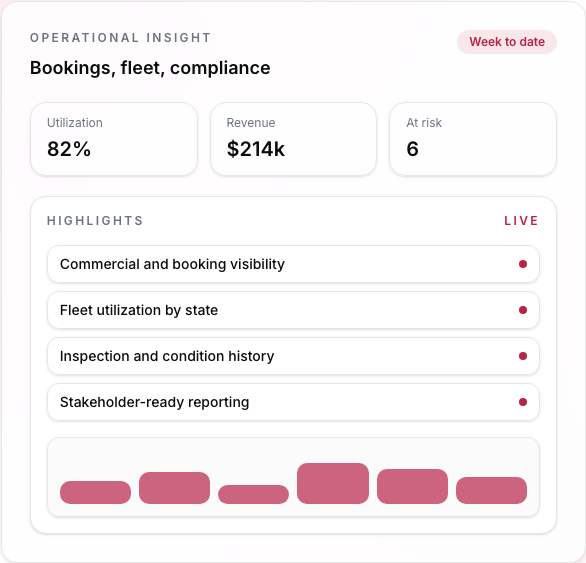
Booking Command Center highlights

Vehicle availability and swapsInspections, handoffs, and signaturesPricing adjustments and payment statusTasks, reminders, and ownership

Current vehicle states

Available
In rental
In inspection
In maintenance
In movement
Branch, category, and status filters
Inspection and handoff progress tracking
Upcoming maintenance, movements, and due tasks

Outcomes teams can measure from day one

Resvo centralizes daily execution so operators move faster with clearer ownership, stronger readiness, and fewer avoidable disruptions across locations.

Suggested 90-day KPI targets

95%+

On-time task completion

Assigned operational work closes within due windows.

<15 min

Pickup handoff cycle

Checklist, signature, and evidence completed in one workflow.

<24 hrs

Condition variance closure

Inspection and handoff mismatches are reviewed and resolved quickly.

100%

Traceable rental records

Each operational event mapped to owner, timestamp, and status.

Speed and throughput

Dispatch, swaps, handoffs, and branch coordination run in one visible flow, so teams execute faster without status chasing across channels.

Error and risk reduction

Template-driven inspections, proof capture, and auditable history reduce missed steps, inconsistent decisions, and avoidable dispute exposure.

Availability and utilization

Planned movements and rule-triggered maintenance keep vehicles in the right place and reduce surprise availability gaps during peak demand.

Team efficiency and accountability

Task ownership, due states, and completion history make responsibility explicit, so managers track progress without manual follow-up loops.

Management confidence and control

Leaders trust operational status because pickups, returns, inspections, and decisions are captured in-system with clear responsibility and evidence continuity.

Start with conservative targets, then calibrate by branch volume, fleet mix, and current operational baseline.

Capabilities that make operations more reliable every day

Each capability is designed to remove daily friction and improve execution quality across branches, teams, and rental statuses.

Booking Command Center

Operate every rental from one command center

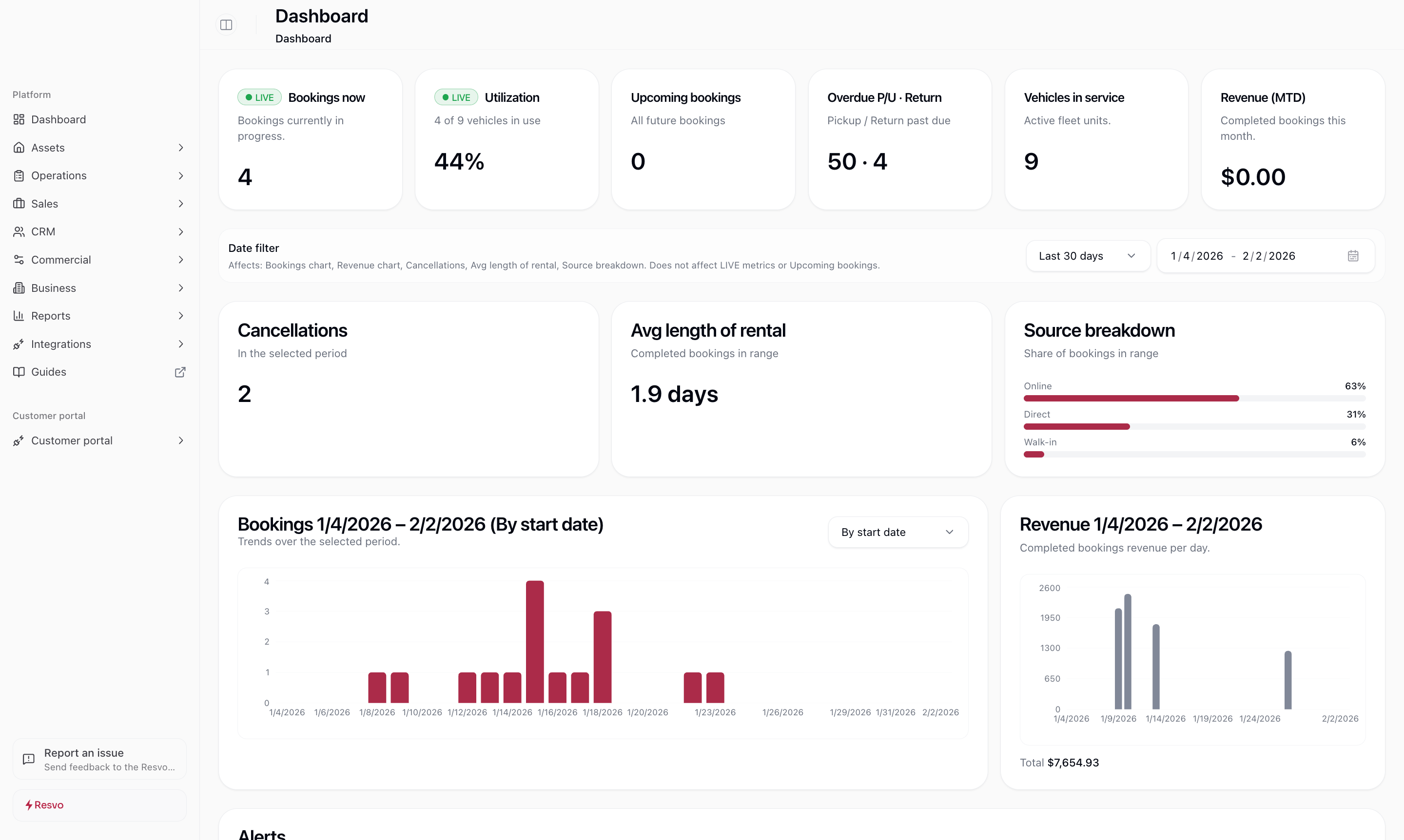
Booking Command Center unifies customer, vehicle, payment, and task context in one live record from draft to completed. Teams execute every operational step in one place, which shortens exception resolution and keeps ownership clear.

When rental context is split across tabs, chat threads, and side tools, teams lose time, miss steps, and resolve issues late.

A single operational record per rental improves decision speed, reduces execution errors, and keeps accountability clear through every status change.
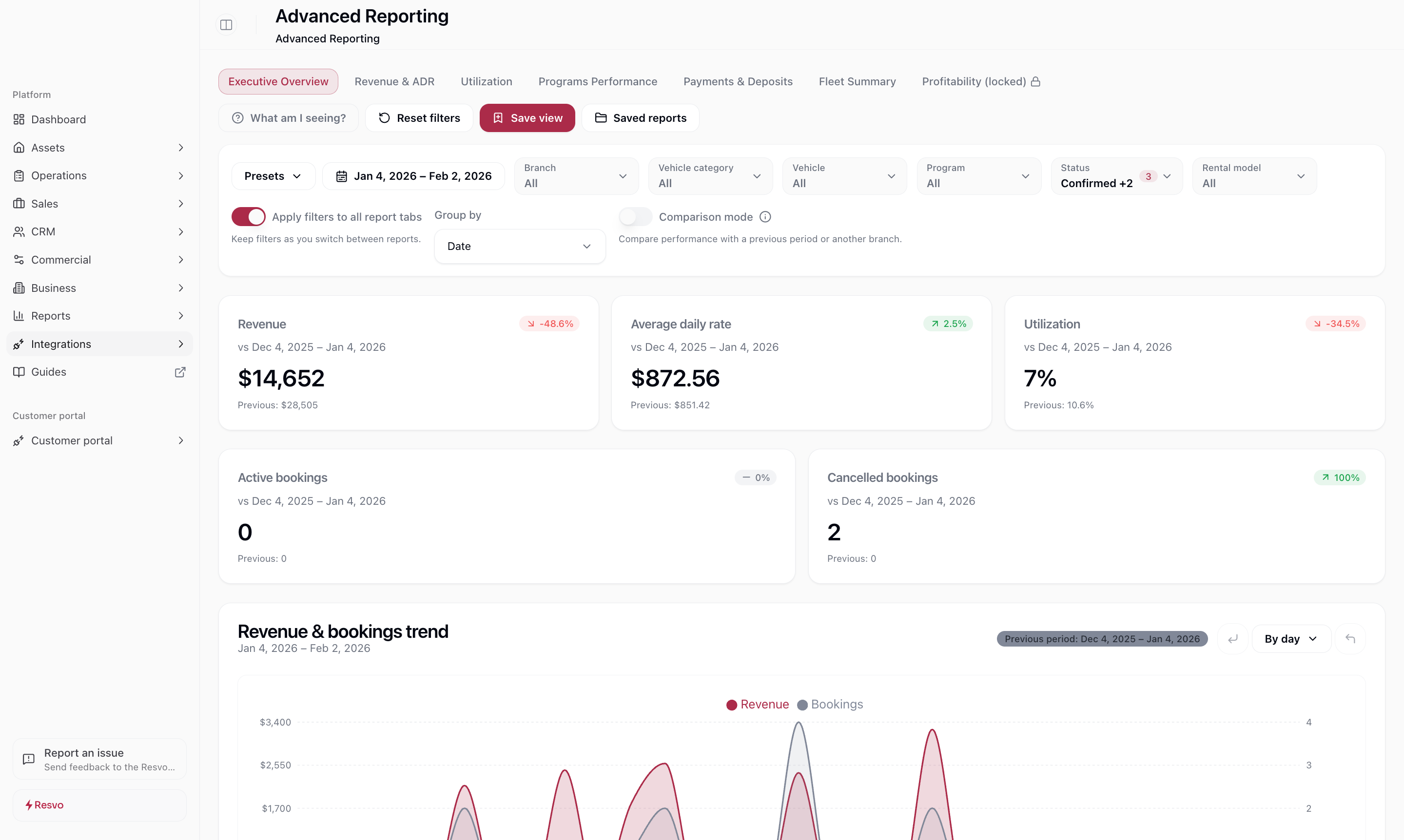
Booking Command Center with full rental context in Resvo

30-40%

Faster exception resolution

Teams typically reduce booking and handoff exception resolution time by 30-40% when execution is centralized in one command workspace.

Teams see customer, vehicle, status, and payment context in one workspace before taking action.

Lifecycle progression from Draft to Completed stays visible in one timeline.

Swaps, inspections, handoffs, signatures, and tasks are executed without leaving the record.

Multi-Branch Movements

Position vehicles intentionally across branches

Multi-Branch Movements plans and tracks transfers as owned events with ETAs and status history. Branch teams can reposition fleet ahead of demand, which improves transfer reliability and reduces last-minute operational friction.

Without a structured movement workflow, repositioning stays reactive and vehicles arrive late to the demand that needs them.

Planned positioning improves availability where demand is expected, reduces idle time, and lowers last-minute transfer friction.

Multi-branch movement scheduling and ownership in Resvo

95%+

On-time branch transfers

With assigned owners, ETAs, and live status tracking, teams typically maintain 95%+ on-time inter-branch transfer completion.

Operators confirm origin, destination, ETA, and assigned owner before each transfer starts.

Movement status and handoff history remain visible for every branch involved.

Availability updates automatically as transfers move from scheduled to completed.

Reminders & Tasks

Turn obligations into owned, trackable execution

Reminders and Tasks converts renewals, prep steps, inspections, maintenance follow-ups, and internal work into structured tasks. Teams assign owners, track due states, and mark completion with full visibility. Execution history stays available for audit and coaching.

When obligations live in memory or informal communication, deadlines slip and no one can prove what was completed on time.

Clear task ownership and status control improves execution pace, reduces missed follow-ups, and strengthens accountability.

Operational reminders and tasks queue with ownership in Resvo

95%+

Target on-time closure

With assignment rules and due-state visibility.

Teams prioritize work from one queue with due, overdue, and completed states.

Each task has a clear owner, so accountability is visible without side-channel follow-up.

Managers can review completion history by person and timestamp in one activity trail.

Downtimes & Maintenance

Protect availability by controlling downtime as a state

Downtimes and Maintenance manages vehicle unavailability as a controlled operational state, not an informal note. Maintenance events can be triggered by time, mileage, inspection outcomes, or custom rules. Availability updates automatically while the vehicle is out of service.

Reactive maintenance and manual tracking create surprise unavailability and scheduling conflicts across active demand.

Planned downtime reduces disruptions, protects utilization plans, and helps teams return vehicles to ready status faster.

Vehicle downtime and maintenance status management in Resvo

0 blind spots

Downtime visibility

Out-of-service states update availability in real time.

Staff can see why a vehicle is out of service, who owns the task, and when it should return.

Downtime can be triggered by mileage, inspection outcomes, or scheduled service intervals.

Availability returns automatically when work is completed and the vehicle is marked ready.

Fleet Inspections

Standardize condition evidence without rigid workflows

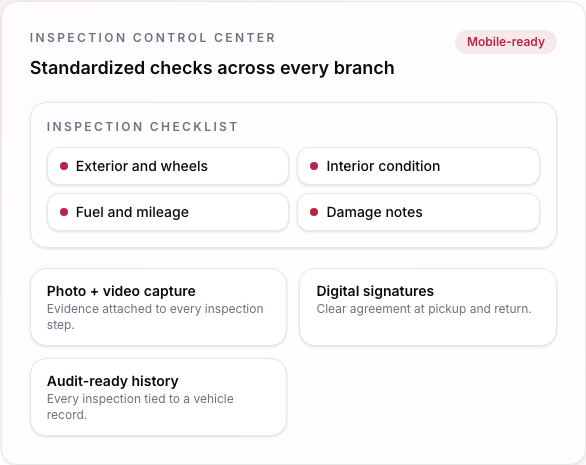
Fleet Inspections provides customizable workflows for pre-rental, post-rental, maintenance return, routine checks, and random audits. Evidence is captured in structured records tied to vehicle history. Inspection outcomes can trigger follow-up actions automatically.

Generic checklists and inconsistent routines create uneven evidence quality and weak condition accountability.

Flexible inspection standards improve consistency, strengthen defensibility, and produce actionable condition intelligence.

Configurable fleet inspection workflow and evidence capture in Resvo

100%

Structured condition evidence

Template-driven inspections with audit-ready records.

Teams run inspection templates mapped to pre-rental, post-rental, service return, or audit scenarios.

Condition evidence is captured with photos, notes, and structured issue markers.

Before-and-after condition records stay linked to the rental history for faster resolution.

Customer Handoffs

Make every pickup and return consistent and defensible

Customer Handoffs structures pickup and return through guided workflows for on-site, off-site, and delivery scenarios. Teams capture signatures and supporting evidence while assigning responsibility to staff members. Each handoff is tied to the rental lifecycle and inspection history.

Unstructured handoff moments create disputes, delays, and unclear responsibility at rental start and rental end.

Consistent handoff execution shortens turnaround time, reduces friction in claims, and protects team accountability.

Guided customer handoff flow with signatures and evidence in Resvo

<15 min

Target handoff cycle

Checklist, signature, and evidence captured in one flow.

Pickup and return steps are guided so teams complete the same checks every time.

Signatures and supporting evidence are captured in the same handoff flow.

Each handoff remains linked to inspection history and assigned staff ownership.

Inspections Analyst (AI)

Add a second layer of inspection oversight with AI

Inspections Analyst uses AI to review inspection evidence and compare vehicle condition at rental start versus rental end. It highlights inconsistencies, subtle differences, and potential risks that manual review can miss. Teams keep full control and decide final action.

As booking volume and complexity increase, human-only review misses edge cases and slows dispute resolution.

AI-assisted review improves detection confidence, speeds case handling, and helps reduce avoidable dispute leakage.

AI-assisted inspection comparison and risk highlights in Resvo

<1 hr

Target discrepancy reviews

AI-assisted triage is designed to flag and route discrepancy reviews in under one hour.

AI surfaces subtle condition differences between start and end inspection evidence.

Risk flags include linked photos and context so reviewers can resolve cases faster.

Teams keep control with clear actions to acknowledge, escalate, or close each case.

How it works together in one real rental flow

From return to next pickup, triggers and ownership stay connected

  1. 1A vehicle is returned and the booking record remains the command center for every next action.
  2. 2Post-rental inspection evidence is captured and a condition issue is detected.
  3. 3That result triggers a maintenance downtime event with an assigned owner and expected return date.
  4. 4When service is completed, the vehicle is marked ready and a movement is scheduled to the branch with upcoming demand.
  5. 5At pickup, staff executes a guided handoff with checklist, signature, and evidence capture in the same workflow.
  6. 6Inspections Analyst compares start and end condition records, flags a subtle mismatch, and routes it for review.
  7. 7Management confirms completion, ownership, and audit history from one connected operational timeline.

System signals visible during this workflow

Live

Vehicle readiness state

Updates automatically as downtime, inspections, and handoffs progress.

Assigned

Operational ownership

Every action has a named owner before the next stage begins.

Auditable

Evidence continuity

Inspection files, signatures, and AI review stay linked in one history.

Branch managers see the same truth as front-line operators in real time.

Escalations are based on state and evidence, not memory or chat recaps.

This is the system effect: capabilities reinforce each other so execution stays fast, defensible, and manageable at scale.

What operators report after standardizing operations in Resvo

These examples reflect teams replacing ad-hoc coordination with one operational system and clear ownership.

We stopped running daily operations from chat threads. The booking record became our command center and handoff mistakes dropped quickly.

100%

Traceable handoff ownership

Operations Manager

Multi-branch rental company

Downtime and movement planning finally became predictable. We spend less time firefighting and more time keeping availability aligned with demand.

95%+

On-time operational tasks

Fleet Supervisor

Regional rental operator

Inspection and handoff disputes are easier to resolve because every action, signature, and evidence trail is already connected.

<24 hrs

Condition discrepancy closure target

Branch Director

Independent rental network

See how your operation runs with one connected system

Walk through your current workflow with a Resvo specialist and see where command center execution, tasks, and inspections can tighten control quickly.

Map current workflow and escalation pathsDefine KPI baseline and 90-day targetsAlign branch-level ownership and rollout plan

Questions operators ask before implementing Operations Hub

These answers cover rollout, customization, integrations, AI behavior, and data control.

How long does implementation usually take?

Most teams go live in phased steps. We map your current workflow first, configure priorities, and roll out with operator training so daily execution remains stable.

Can the workflows be configured to match how our branches operate?

Yes. You can configure inspections, handoffs, task triggers, and downtime logic to match local operating reality while keeping consistent controls across the network.

How does this connect with our existing systems?

Operations data can integrate with your broader Resvo setup and connected tools so status, customer context, and financial signals stay aligned across teams.

Does AI make decisions on our behalf?

No. Inspections Analyst provides review support by highlighting potential issues. Your team remains in control of operational decisions and final resolution.

Who owns our data and operational history?

You do. Resvo stores structured operational history with permissions and auditability so your team retains clear ownership and access control.